In Mandera, inclusive education is moving beyond policy into practice. Through a UNICEF-supported project implemented by RACIDA, teachers, parents and communities are gaining the knowledge and tools to challenge stigma, support visually impaired children and create more inclusive classrooms.
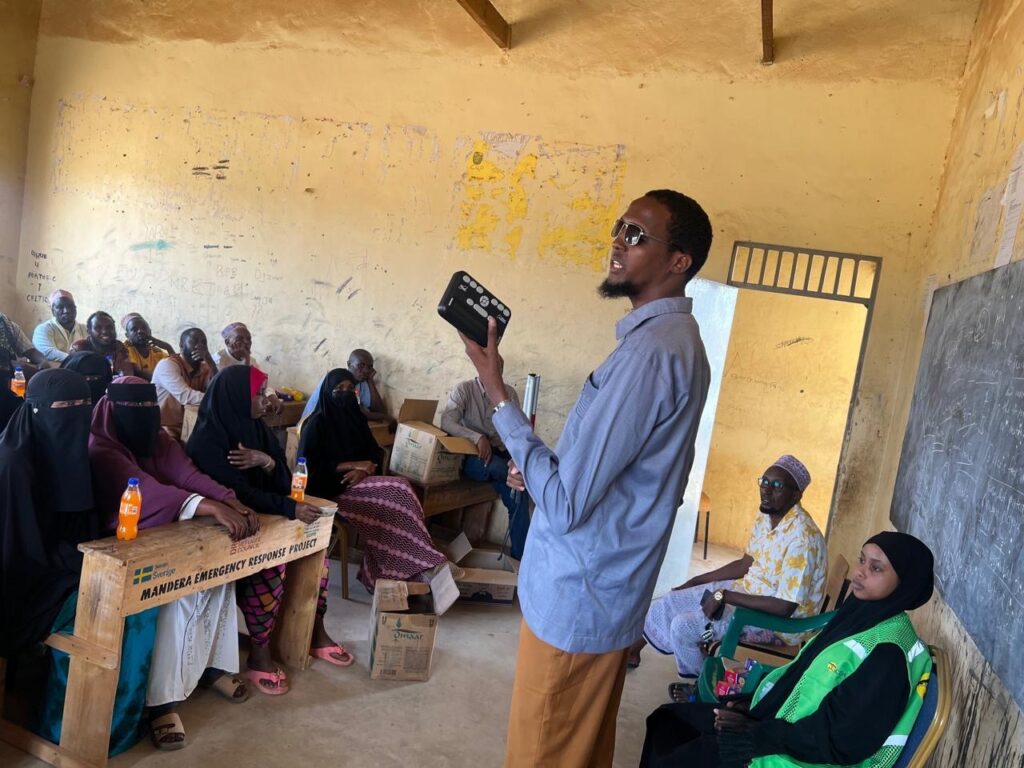
At Mandera Special School for the Blind, Teacher Abdilatif engages parents and communities to challenge stigma and promote positive attitudes towards children with visual impairments.
At a school for the blind, a teacher who cannot see the board is showing children how to read with their hands.
A chalk line he cannot see. A letter a child can hold.
Abdilatif Adan Mohamed stands at the board at Mandera Special School for the Blind, a white cane in one hand and the lesson in the other. In one class, he walks learners through equity, discrimination and solidarity. In another, a child works a Braille typewriter while a tray of studded bricks sits open on the desk.
Each brick is a letter.
For a learner who cannot read the chalkboard, the lesson stops being something recited and becomes something built.
But the change is not only happening inside the classroom.
Through the project, parents and community members are being sensitised on positive disability attitudes, helping address stigma and discrimination against visually impaired children. Teachers are being strengthened on inclusive education and learning through play, while schools are being supported to use LEGO Braille Bricks to improve access to early Braille literacy. The project document specifically identifies community sensitisation, teacher capacity-building and LBB as core components of the intervention.
The impact begins with people.
Abdilatif is one of them.
He is blind. He is a teacher. And through his role in the project, he helps parents and community members see disability differently.
His presence is itself a lesson: visual impairment does not define a child’s potential, a teacher’s ability or a person’s contribution to society.
From awareness to action
The project is designed to address some of the barriers that keep children with disabilities from accessing and remaining in school.
In Mandera, specialised education services remain limited. The programme therefore combines teacher capacity-building, inclusive learning tools, community engagement and efforts to address stigma and discrimination.
Five schools in Mandera East and Mandera North are being reached through the LEGO Braille Bricks component. Teachers of pre-primary, Grades 1 to 3 and special-needs classes are trained on LEGO Braille Bricks, learning through play and inclusive education. The project also supports monitoring of LBB kits and the establishment of a community of practice to strengthen basic Braille literacy and learning through play among teachers.
Parents and caregivers are part of the change.
The project seeks to increase their understanding of inclusive education, learning through play, rights and responsibilities, while strengthening their capacity to advocate for and support the inclusion of all children in education.
This matters because stigma can be as powerful a barrier as the absence of equipment or trained teachers.
Changing attitudes therefore becomes part of changing access.
A teacher who changes the conversation
For Abdilatif, sensitising parents and community members is not simply another project activity.
It is personal.
He knows what it means to navigate education as a blind person. Now, as a teacher at Mandera Special School for the Blind, he brings that lived experience into conversations about disability, challenging assumptions about what children with disabilities can achieve.
He teaches through example.
A blind teacher standing in front of a classroom changes the conversation before he says a word.
And when he speaks to parents and community members about positive disability attitudes, he is not speaking theoretically. He is showing them what inclusion looks like.
The change goes beyond disability inclusion.
The result is an approach that does not treat inclusion as a separate intervention.
It works on the classroom, the teacher, the family and the community at the same time.
Standing with teachers
World Teachers’ Day, 5 October 2026, marks 60 years of the ILO/UNESCO Recommendation on the Status of Teachers. This year’s theme is “Standing with teachers.”
In Mandera, standing with teachers means giving them the skills, tools and support to reach children who have historically been left behind.
It also means recognising teachers like Abdilatif—not because he is a teacher who happens to be blind, but because he is a teacher whose experience helps others understand why inclusion matters.
For now, the change is visible in the people around them.
A child reaches for a Braille brick.
A teacher places a lesson within reach.
A parent begins to see disability differently.
And a blind teacher stands at the board, showing what inclusion looks like.
Because blindness should never decide who gets to learn.
And it should never decide who gets to teach.
RACIDA implements this work with UNICEF Kenya, the Ministry of Education, the Kenya Institute of Special Education and the Mandera County Government, with support from the European Union and the LEGO Foundation.