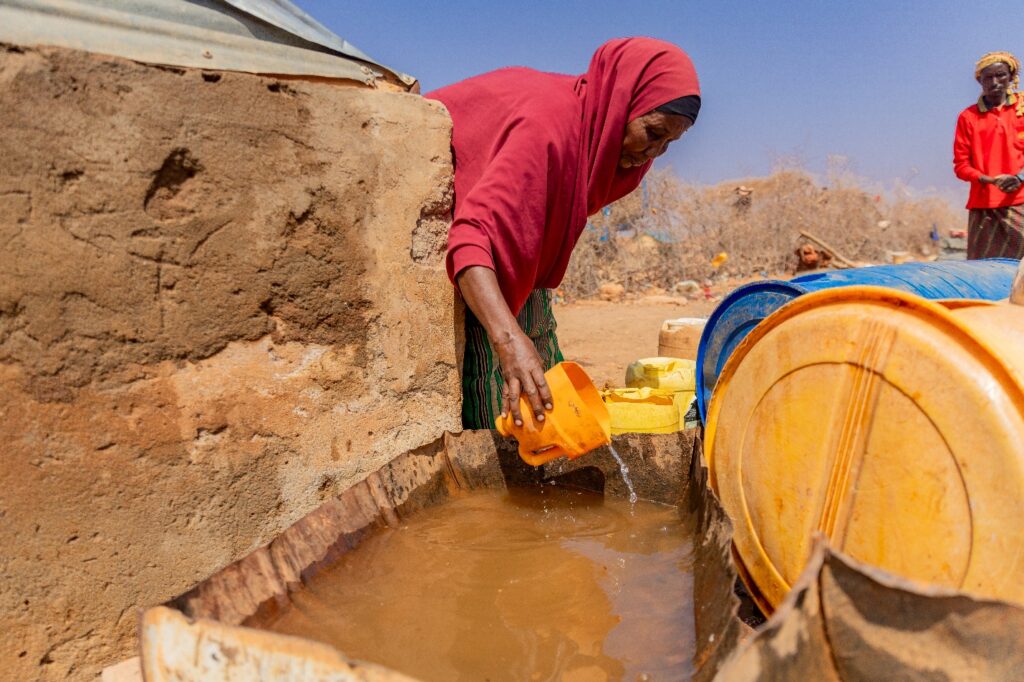
In the lowlands of Ethiopia, Kenya, and Somalia, a cruel paradox shapes daily life. Torrential rains unleash flash floods one season, only to give way to unrelenting drought that withers livestock, displaces families, and weakens the foundations of pastoralist life. For decades, the humanitarian response has often followed a familiar pattern: emergency food assistance, temporary shelter, and short-term health support. Yet as climate shocks intensify, this reactive model is yielding diminishing returns and leaving communities increasingly vulnerable.
This World Humanitarian Day, the Rural Agency for Community Development and Assistance (RACIDA) offers a different calculus. Operating across the fragile Mandera Triangle, which straddles northern Kenya, southern Ethiopia, and south-central Somalia, RACIDA works at the intersection of humanitarian response, climate adaptation, resilience, and local peacebuilding. Its approach is grounded in a practical conviction: build systems, not dependency.
For RACIDA, humanitarian action is not only the delivery of supplies. It is an investment in institutional resilience, a restoration of human dignity, and a long-term bet on the ability of pastoralist and agro-pastoralist communities to shape their own futures through assistance that is safe, inclusive, transparent, and accountable.
A Region on the Frontlines of Climate Crisis
The arid and semi-arid lowlands of Ethiopia, Kenya, and Somalia lie on the frontlines of the global climate emergency. The rains, when they come, are often destructive; when they fail, the region plunges into severe water scarcity. Across these borderlands, millions face threats not only to their livelihoods, but to the very fabric of pastoralist life that has sustained these lands for centuries.
Since 2001, RACIDA has evolved from a local initiative into a regional, community-rooted humanitarian and development actor, with field offices spanning Ethiopia, Kenya, and Somalia. Anchored in a Community Managed Disaster Risk Reduction approach, its strategy rests on a singular premise: those who live with the risk must lead the response.
Dignity Through Choice and Accountability
RACIDA’s experience with cash assistance in Kenya’s Mandera and Wajir counties, Ethiopia’s Liban region, and Somalia’s Gedo region demonstrated that RACIDA’s model is not isolated to one response. Across these contexts, cash assistance has become a practical expression of dignity, choice, and accountability: it enables affected families to decide for themselves whether their most urgent priority is food, water, treatment, school costs, debt repayment, transport, or restarting a small livelihood activity.
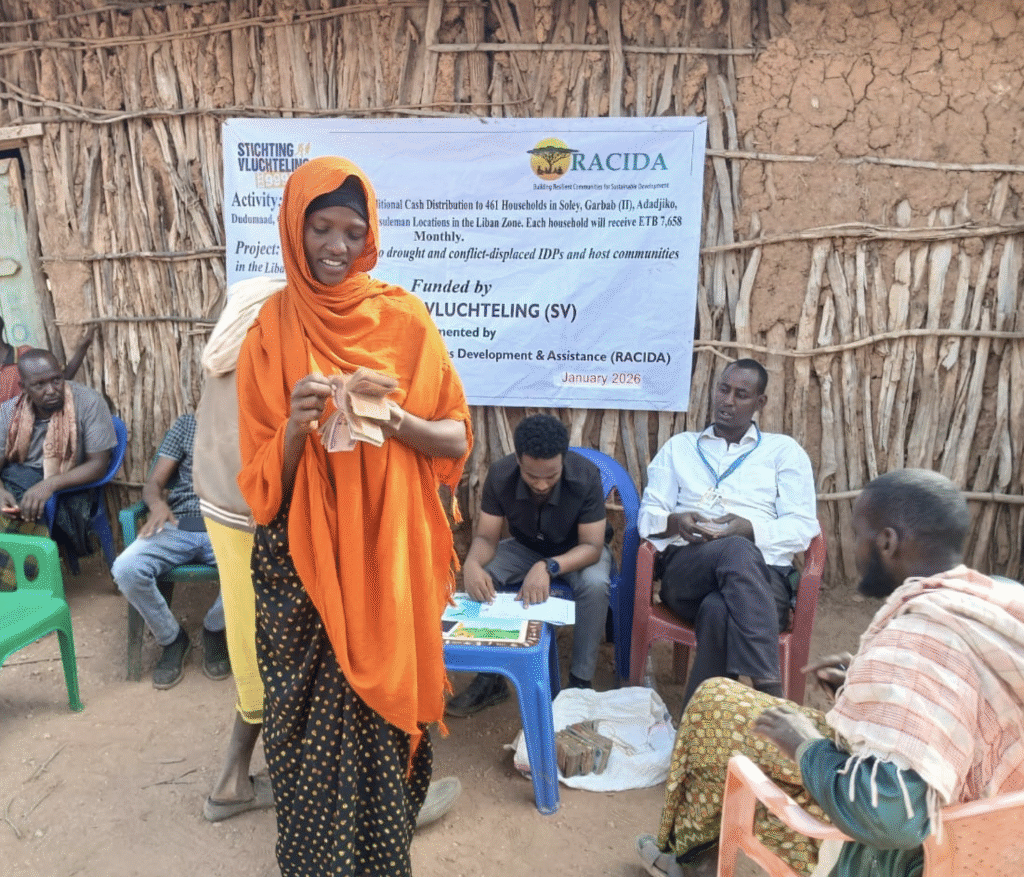
Recently in Mandera County, RACIDA’s cash transfer response has demonstrated huge impact and how cash assistance brought humanitarian assistance meeting urgent needs, preserving dignity of vulnerable communities, choice, and accountability. Between January and March 2026, RACIDA is distributed KES 191.5 million in cash assistance to 7,493 drought- and conflict-affected households across Mandera County, supported by OFA/State Department, Diakonie Katastrophenhilfe, and ACTED. The response includes 6,385 households under the OFA/State Department-funded drought response receiving KES 8,645 per month for three months, 384 households under the DKH-funded cross-border emergency response receiving KES 12,277 for two cycles, and 724 households under the ACTED-funded Kenya Cash Consortium response receiving KES 11,412 for two months. In parallel, 1,250 households are receiving essential Non-Food Items, reinforcing RACIDA’s integrated approach to immediate relief and household resilience.
The story of Abdia Abdullahi Hussein, a single mother in Sala village, Lafey Sub-County, shows what these figures mean at household level. With cash support, Abdia was able to make the decisions that mattered most for her family: keeping her children in school, seeking medical treatment when needed, meeting urgent household needs, and restarting a small kiosk. Her experience captures why cash assistance is central to RACIDA’s resilience model. It is not only a transfer of money; it is a transfer of choice, trust, and the ability to recover with dignity.
In Ethiopia’s Liban Zone, recent prolonged drought and inter-communal conflict have pushed many families to the precipice. With support from Stichting Vluchteling, RACIDA Ethiopia identified and registered 461 vulnerable households for unconditional cash transfers in Dollo-Ado, Filtu, and Dhekasuftu. The choice of cash over in-kind food aid was deliberate: it preserved household agency while allowing vulnerable IDPs and host communities to prioritise their own recovery needs.
In Wajir County, RACIDA, with support from Diakonie Katastrophenhilfe, delivered unconditional multi-purpose cash assistance to drought-affected households in locations including Gubat Onle, Ahmed Garweyne, Wel Athi, Dalsan, and Fororsa. The impact was visible not only in improved access to food and basic needs, but also in restored confidence and reduced negative coping strategies. For Arabey Adan, a mother of eight in Wel Athi, the assistance meant no longer relying on food bought on credit, returning children to school, repaying debts, and slowly reviving her small kiosk.
In Somalia’s Gedo region, under Deris Wanaag, RACIDA’s cash assistance approach also reflects the same principle: affected communities are supported in ways that protect dignity, reduce immediate pressure, and allow households to make decisions based on their own circumstances. Whether responding to drought, displacement, food insecurity, or livelihood disruption, the cash model recognises that communities understand their needs best and should have meaningful control over how assistance is used.
Importantly, RACIDA is known for transparency in implementing cash assistance. Targeting, selection, and identification are carried out through community-informed assessments, clear eligibility criteria, open validation processes, household verification, and accessible complaints and feedback channels. Community elders, local structures, affected households, and field teams help verify that assistance reaches those most affected, while grievance mechanisms give people a safe way to ask questions, challenge decisions, or report concerns.
“The transparent approach minimised disputes and ensured widespread acceptance of the final lists,” noted Abdi Abdullahi, a community elder familiar with the process. By combining cash assistance with accountable targeting, community validation, and real-time feedback, RACIDA transforms emergency support into a locally owned mechanism for dignity, trust, and recovery. The result is assistance that does more than meet immediate needs: it reinforces agency, strengthens social acceptance, and helps affected families take the first steps from relief toward resilience.
From Relief to Resilience
The true test of humanitarian action is not only whether it saves lives today, but whether it leaves communities better able to face tomorrow. Across the Mandera Triangle and wider Horn of Africa borderlands, RACIDA’s programmes show how emergency response can become a bridge to dignity, recovery, peace, and long-term resilience.
Through the Hanaano Programme, implemented with Concern Worldwide and partners under Irish Aid support, RACIDA contributes to a cross-border effort to prevent child wasting in the Mandera Triangle by addressing the root causes of malnutrition. By integrating nutrition, livelihoods, WASH, natural resource management, gender equality, social behaviour change, and conflict sensitivity, Hanaano moves beyond treating malnutrition after it occurs and instead strengthens the household and community systems that help prevent it in the first place. In Mandera, this systems approach is also visible in practical livestock and dryland farming support, from animal health interventions to water pumps and farmer training along the River Dawa, helping families protect both nutrition and livelihoods before the next shock arrives.
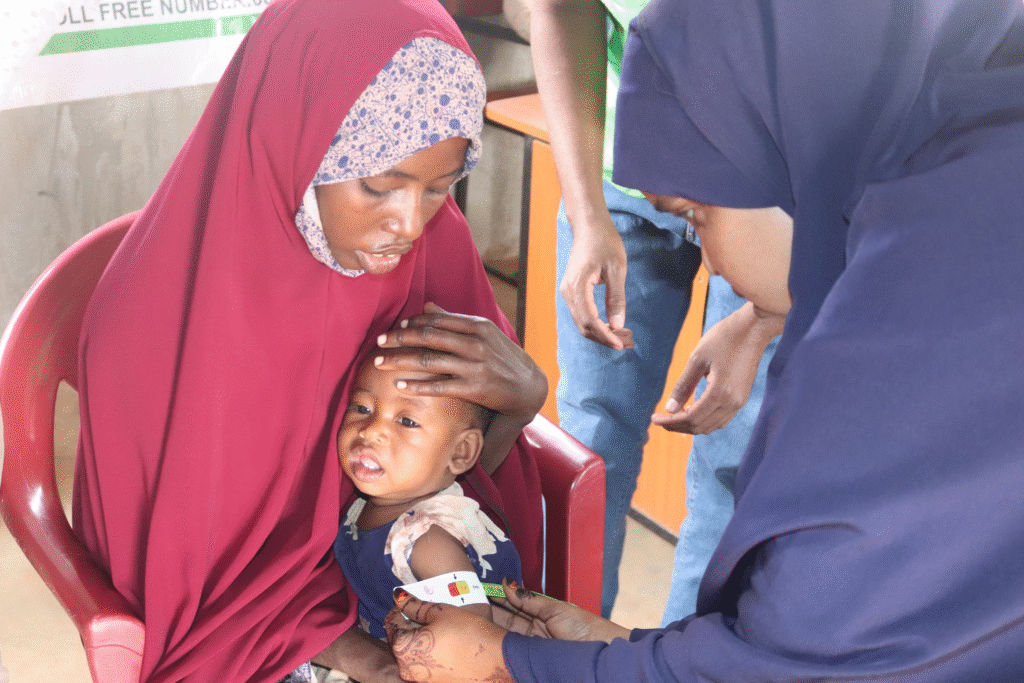
With support from Stichting Vluchteling, RACIDA Ethiopia’s work in Liban Zone demonstrates how emergency relief can protect dignity while strengthening accountability. The identification, validation, and registration of 461 drought- and conflict-affected households in Dollo-Ado, Filtu, and Dhekasuftu for Unconditional Cash Transfers gives vulnerable IDPs and host communities the power to prioritise their own urgent needs. The process—anchored in community-based targeting, open validation, household spot-checks, and real-time feedback—turns cash assistance into more than a lifeline; it becomes a transparent, locally owned mechanism for preserving choice, reducing disputes, and sustaining trust.
The BORESHA-NABAD programme, funded by the European Union and Danida and implemented through a regional consortium led by the Danish Refugee Council, advances resilience through peaceful coexistence, climate-smart livelihoods, and stronger cross-border collaboration in Kenya, Somalia, and Ethiopia. By linking disaster risk reduction, conflict prevention, local economic recovery, market systems, climate-smart agriculture, water resource management, and peace dialogue, the programme responds to the shared nature of risk in the borderlands. Its work on rehabilitating degraded land, restoring productive pasture, supporting adaptive farming, and facilitating community-led peace processes shows that resilience in the Mandera Triangle is both ecological and social.
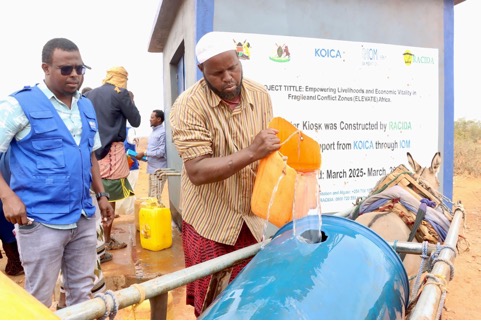
Through the ELEVATE Project, implemented with IOM and KOICA support, RACIDA links peacebuilding with economic resilience in displacement-affected communities in Mandera. The project strengthens social cohesion through inclusive dialogue while expanding pathways to livelihoods through labour market assessment, vocational skills, climate-smart agriculture, and support to marginalised groups. In a context where climate shocks, displacement, and conflict reinforce one another, ELEVATE shows that recovery must include both income and trust: communities need practical skills to rebuild livelihoods, and shared platforms to resolve grievances before they become new crises.
The Building Resilience of Agro-Pastoralist Communities Project supported by BMZ, Diakonie Katastrophenhilfe, and Brot für die Welt further anchors RACIDA’s long-term resilience agenda in Mandera, Wajir, and Ethiopia’s Liban Zone. Through training in sustainable dryland farming, drought-resistant crops, fodder production, beekeeping, micro-grants, and support to community-led response, the project helps agro-pastoralist communities recover from drought, floods, and conflict while diversifying income and reducing dependence on a single livelihood source. Its focus on community groups and locally led initiatives reflects the same humanitarian principle at the heart of this case study: affected people are not passive recipients of assistance; they are the first builders of their own resilience.
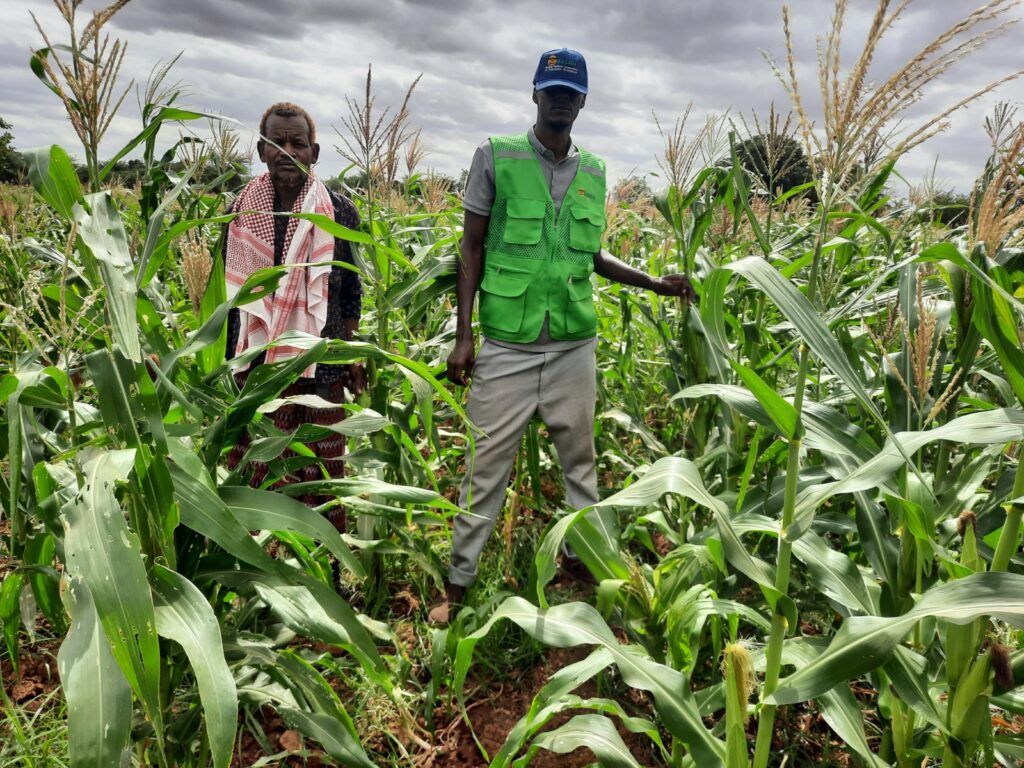
Together, these interventions show that RACIDA’s work is not a collection of isolated projects, but a connected resilience pathway. Cash assistance protects dignity in moments of crisis; nutrition, WASH, and animal health interventions prevent deterioration; livelihoods and skills training rebuild local economies; water and natural resource systems reduce pressure over scarce resources; peacebuilding strengthens social cohesion; and agro-pastoral investments help communities withstand the next shock. This is the practical meaning of building systems, not dependency—and it is a fitting message for World Humanitarian Day.
Water as a Pathway to Peace
In the Horn of Africa, water scarcity can quickly become a catalyst for conflict. Competition over dwindling wells and seasonal rivers can inflame clan tensions and weaken social cohesion. RACIDA is challenging this narrative by positioning water not as a source of division, but as a foundation for peace.
In Ethiopia, RACIDA with partnership and support from the U.S. Department of State-supported Climate Resilient Water, Sanitation, and Hygiene Activity in the Somali Region of Ethiopia, helping communities rehabilitate defunct water points while establishing or revitalising inclusive management structures. By bringing elders, clan leaders, and customary institutions to the table, water governance is rooted in local legitimacy rather than external imposition.
When communities co-manage a strategic water point, they negotiate usage rights, maintenance responsibilities, and conflict resolution mechanisms. Rebuilding a well or borehole becomes an act of rebuilding trust—a vital prerequisite for long-term peace and shared development among pastoralist communities.
A Legacy of Hope and Local Leadership
As we celebrate World Humanitarian Day, the world pays tribute to responders who brave the most unforgiving conditions to save lives. Across Kenya, Ethiopia, and Somalia, RACIDA’s teams work shoulder-to-shoulder with government bodies, UN agencies, international organisations, and local NGOs to deliver critical humanitarian support. Yet, as RACIDA marks over 20 years of service, its leadership insists that emergency response is only the beginning of its mission.
The enduring goal is to help ensure that communities require less emergency assistance tomorrow. That means protecting dignity through transparency, strengthening resilience through locally owned infrastructure, and supporting communities not as passive recipients of aid, but as active partners in shaping their own prosperity.
The path is not without obstacles. Logistical hurdles, funding constraints, and access challenges remain daily realities in some of the world’s most remote and volatile regions. Yet RACIDA’s added value lies in its local trust, cross-border presence, community-led implementation, and ability to connect emergency response with longer-term resilience and peacebuilding.
Accountability to Affected Populations as a Core Organisational Commitment
RACIDA’s resilience model is anchored in a clear organisational commitment to Accountability to Affected Populations: the people and communities affected by crisis, poverty, climate shocks, displacement, and conflict must be informed, heard, involved, protected, and able to influence the decisions that shape their lives. This commitment goes beyond compliance. It defines how RACIDA uses its presence, resources, partnerships, and decision-making power responsibly—by taking account of community priorities, giving account through transparent information sharing, and being held to account through safe complaints and feedback mechanisms.
Across its programming in Kenya, Ethiopia, and Somalia, RACIDA applies accountability as a practical programming standard. Communities are engaged in assessing needs, validating targeting decisions, shaping implementation approaches, monitoring service quality, and identifying risks or unintended effects. The organisation’s programme cycle therefore reflects a continuous accountability loop: inform communities, listen to their views, respond to feedback, adapt interventions, communicate back, and learn. This makes accountability not a stand-alone activity, but a way of improving programme quality, safeguarding dignity, and strengthening trust.
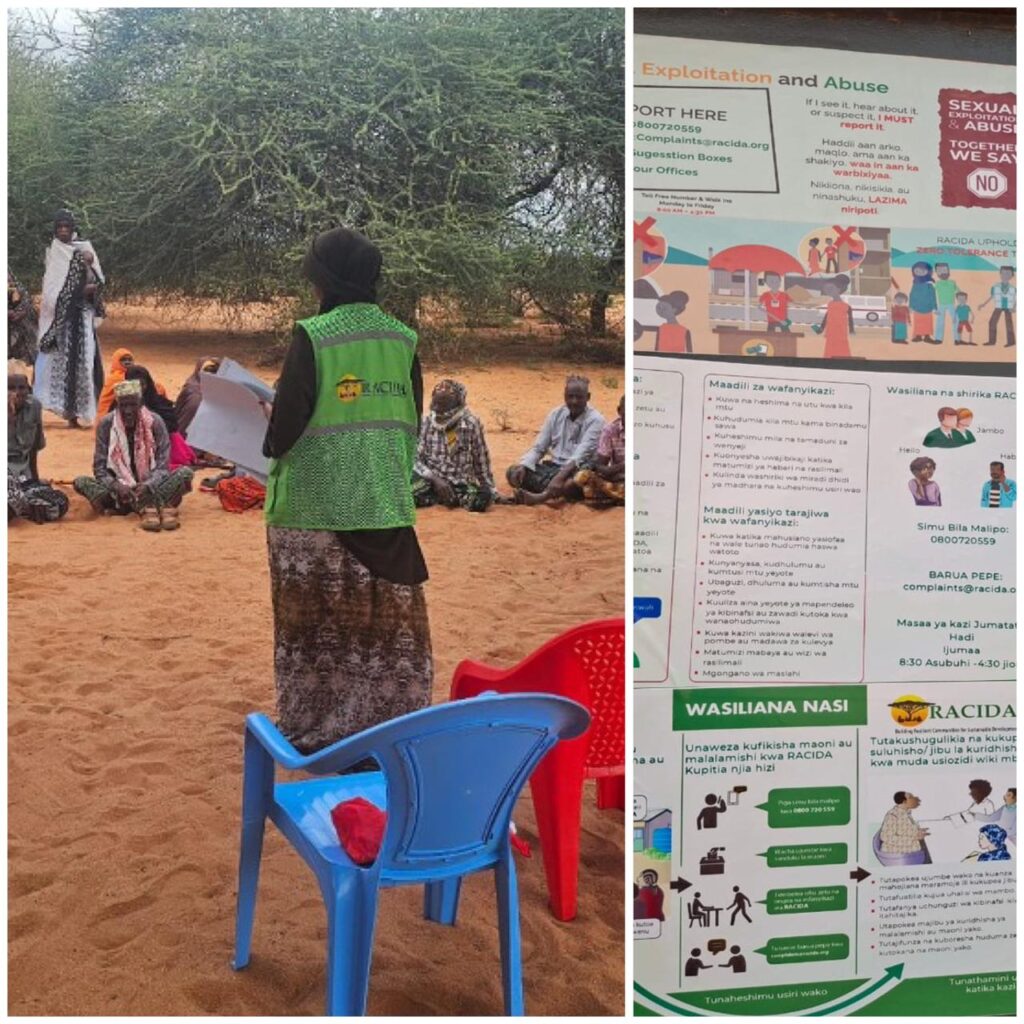
This commitment is visible in RACIDA’s current programme portfolio. In the Unconditional Cash Transfer response in Ethiopia’s Liban Zone, community-based targeting, open validation meetings, household spot-checks, and real-time grievance channels help ensure that assistance reaches vulnerable households transparently and with community acceptance. In the Hanaano Programme, accountability is reflected through integrated nutrition, livelihoods, WASH, natural resource management, gender equality, social behaviour change, and conflict-sensitive approaches that respond to the root causes of malnutrition while recognising community priorities and capacities.
Similarly, BORESHA-NABAD demonstrates collective accountability across borders by linking disaster risk reduction, climate-smart livelihoods, peace dialogue, water resource management, market systems, and local economic recovery in ways that respond to shared risks in the Mandera Triangle. The ELEVATE Project strengthens accountability by combining inclusive dialogue, social cohesion, skills development, climate-smart agriculture, and support to marginalised groups, ensuring that displacement-affected communities participate in rebuilding both livelihoods and trust. RACIDA’s agro-pastoral resilience work further reflects AAP by investing in community-led response, drought-resistant production systems, fodder, beekeeping, micro-grants, and locally owned adaptation measures that reduce dependence and strengthen agency.
In RACIDA’s water governance and peacebuilding work, accountability is expressed through inclusive community structures that enable elders, local leaders, customary institutions, women, youth, and affected households to participate in the management of shared resources. By linking information sharing, participation, feedback, safeguarding, protection, and conflict sensitivity, RACIDA ensures that its interventions are not only technically relevant, but also socially legitimate and locally owned. In this way, Accountability to Affected Populations reinforces the central message of RACIDA’s humanitarian and resilience approach: communities are not passive beneficiaries of aid, but rights-holders, partners, and leaders in building safer, more resilient, and more dignified futures.
A Resilient Future Starts Today
In a world where humanitarian needs rapidly outstrip available resources, the traditional crisis-response model is no longer sufficient on its own. The future demands systemic investment, he philosophy RACIDA distils as “building systems, not dependency.” This World Humanitarian Day, we honour not only those who rush toward disaster, but also those who work tirelessly to prevent it. In the arid landscapes of Ethiopia, Kenya, and Somalia, every drop of water and every seed sown is a bet against an unpredictable climate and a step toward a future in which emergency appeals become less frequent, less severe, and less necessary.
RACIDA is a regional non-profit organisation operating in Kenya, Ethiopia, and Somalia, with a vision of dignified and thriving communities in Arid and Semi-Arid Lands.